
The FDA's Tainted Supplements Database tracks products found to contain undeclared pharmaceutical ingredients — prescription drugs hidden inside products marketed as "natural" supplements. The scale of the problem is significant.
The Tainted Supplements Problem
Between 2007 and 2025, the FDA identified over 1,000 tainted supplements. The three highest-risk categories:
The most commonly found hidden ingredients include sildenafil and its analogs (in sexual enhancement products), sibutramine (in weight loss products — a drug removed from the market for cardiovascular risk), and anabolic steroids (in muscle-building products).
Why Recalls Don't Fully Protect Consumers
- Voluntary compliance: Most supplement recalls are voluntary. The FDA can request a recall, but mandatory recall authority is limited.
- Speed: Months can pass between FDA identification of a tainted product and its removal from shelves.
- Online sales: Products recalled from retail often remain on Amazon marketplace, eBay, and independent websites.
- Reformulation: Some companies respond to recalls by slightly reformulating and relaunching under a new name.
Adverse Event Reporting
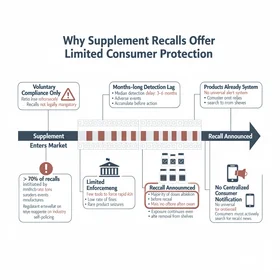
Since 2007, supplement companies have been required to report serious adverse events to the FDA. The CAERS system receives approximately 4,000-5,000 supplement-related reports per year. However, reporting by consumers and healthcare providers is voluntary — so actual adverse events are estimated at 10-100x higher than reported.
The most serious events tend to involve multi-ingredient products, pre-workouts with high stimulant loads, and products marketed for sexual enhancement or weight loss. Understanding how the FDA regulates supplements helps explain why these gaps persist.
How to Protect Yourself
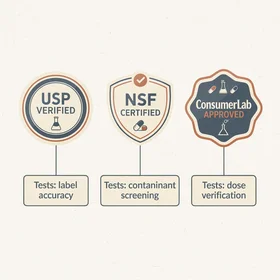
- USP Verified: United States Pharmacopeia tests for identity, potency, contaminants, and dissolution. The gold standard.
- NSF International: Tests for label accuracy, contaminants, and banned substances (NSF Certified for Sport).
- ConsumerLab: Independent testing across hundreds of supplement categories.
- Informed Sport / Informed Choice: Third-party banned substance screening for athletes.
No certification is perfect, but certified products have dramatically lower contamination rates. For specific product recommendations by category, visit comprehensive supplement guides.
Cons & Considerations: What to Watch Out For
Even well-intentioned supplement use carries limitations and safety considerations that consumers should weigh carefully. Being honest about these is part of responsible coverage.
Labeling Accuracy Remains a Systemic Problem
Multiple independent analyses have found significant discrepancies between what supplement labels claim and what products actually contain. A 2023 ConsumerLab report found that approximately 21% of products tested failed quality review — due to containing less of the active ingredient than claimed, exceeding safe levels of contaminants, or listing ingredients not actually present. The FDA’s limited inspection capacity means many of these products remain on shelves indefinitely (ConsumerLab.com Annual Survey, 2023).
Drug-Supplement Interactions Are Underreported
The National Institutes of Health estimates that supplement-drug interactions contribute to thousands of adverse events annually, yet most go unreported. Common high-risk interactions include: St. John’s Wort reducing the efficacy of birth control and antidepressants, high-dose vitamin E increasing bleeding risk with blood thinners, and calcium supplements interfering with thyroid medication absorption. Many consumers do not tell their healthcare providers about supplement use, and many providers do not ask (NIH Office of Dietary Supplements, Dietary Supplement Fact Sheets, 2024).
Proprietary Blends Obscure Dosing
“Proprietary blend” labeling is legal under FDA rules — it allows manufacturers to list ingredients without disclosing individual amounts. This means a product can advertise 10 ingredients but load the blend with the cheapest one. Consumers have no way to verify whether active ingredients are present at clinically studied doses. Caution is warranted with any product that hides behind proprietary blend labeling instead of disclosing per-ingredient amounts.
Side Effects of Common Supplements
Even widely used supplements carry side effect profiles that are frequently minimized in marketing:
- Iron: Gastrointestinal distress, constipation; overdose is a leading cause of poisoning in children under 6 (American Association of Poison Control Centers, 2023)
- Calcium (high-dose): Potential cardiovascular concerns at doses above 1,000mg/day; kidney stone risk in susceptible individuals
- Vitamin D (high-dose): Hypercalcemia at sustained doses above 4,000 IU/day without medical supervision
- Biotin (high-dose): No direct safety concern, but interferes with laboratory tests including troponin (used to diagnose heart attacks), potentially causing misdiagnosis (FDA Safety Communication, November 2017)
- Pre-workout formulas: High caffeine content (200-400mg per serving) combined with stimulants has been linked to cardiac events in sensitive individuals
The Regulation Gap Is Real
The fundamental limitation of the supplement industry is structural: products reach consumers without proving they work. The FDA’s post-market enforcement model means that unsafe or ineffective products can be sold for months or years before action is taken. Consumers should treat the lack of FDA pre-market approval not as a technicality, but as a meaningful gap in the safety net — and compensate by choosing products with third-party testing, transparent labeling, and manufacturers with documented cGMP compliance.